
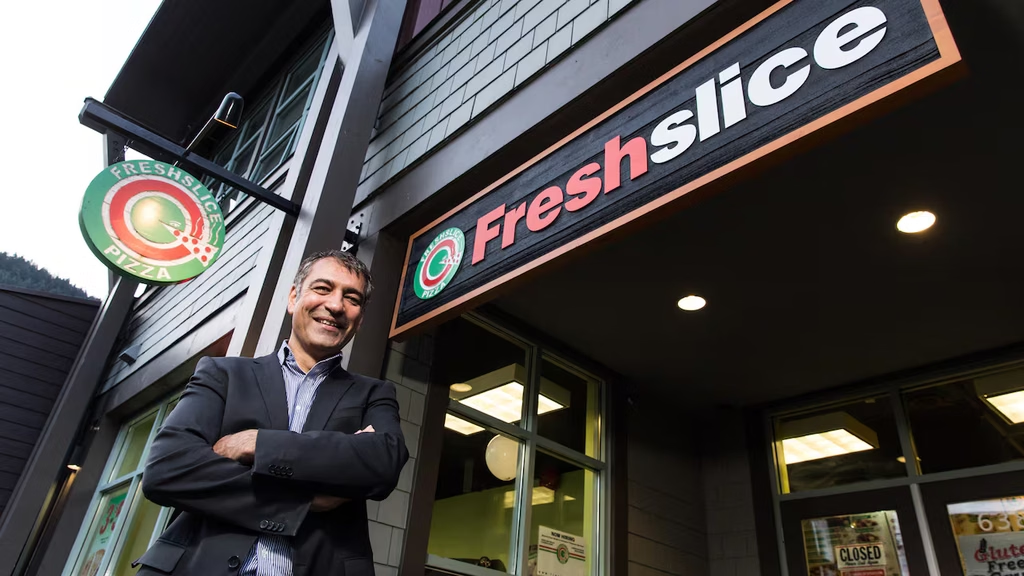
An Educational Look at a Centralized-Production Pizza Business Model
A pizza restaurant may look straightforward from the customer side.
Choose a slice. Customize a whole pizza. Place a delivery order. Pay and enjoy the meal.
Behind that experience, however, is a business that must coordinate food production, inventory, employees, customer traffic, delivery channels, real estate, local marketing, and financial controls.
The Freshslice Pizza franchise provides an interesting example because several elements of the traditional pizza operation are structured differently. Freshslice uses centrally manufactured proprietary dough, a compact restaurant format, pizza-by-the-slice service, customizable whole pizzas, and multiple ordering channels.
Freshslice also publicly emphasizes an unconventional franchise fee structure, including the absence of a conventional percentage royalty and brand advertising fee on core-menu sales.
Those characteristics make the model useful for studying a broader question:
The Elevare Perspective
An operating task does not disappear simply because it moves outside the restaurant.
Centralized production may simplify selected in-store activities. At the same time, it increases the importance of manufacturing, distribution, inventory planning, supplier reliability, and consistent execution across the complete system.
What Does Freshslice Pizza Do?
Freshslice is a pizza concept built around several customer occasions rather than a single ordering format.
The customer proposition includes:
- Pizza by the slice
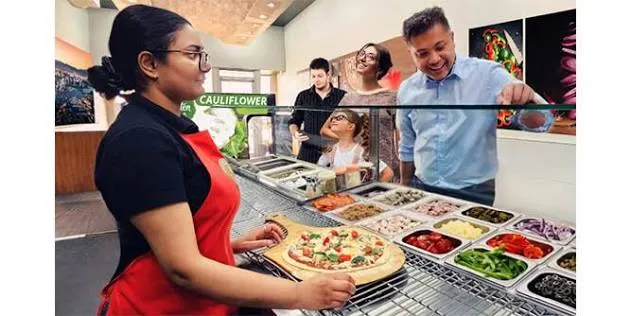
- Customizable whole pizzas
- Takeout
- Pickup
- Delivery
- Limited dine-in depending on location format
That combination allows the restaurant to serve customers who want an immediate meal as well as households or groups ordering complete pizzas.
The operating model is generally built around a relatively compact location and a takeout-oriented customer experience rather than a large traditional dining room.
Centralized Dough Changes the Restaurant Operation
One of the more distinctive elements of the Freshslice operating model is how the dough reaches the restaurant.
Franchise materials describe proprietary dough that is produced centrally, sheeted into crusts, flash frozen, distributed through an approved supplier, and then proofed and prepared at the individual restaurant.
As a result, the local store does not perform every traditional dough-production step from scratch.
Depending on the restaurant, traditional dough preparation may involve mixing ingredients, fermentation, dividing dough, forming dough balls, cleaning specialized equipment, and preparing crusts before service begins.
Moving some of that work upstream may reduce certain equipment, preparation, and training demands inside the restaurant.
However, it does not eliminate restaurant labor.
Employees still need to:
- Receive and store inventory
- Proof and prepare crusts
- Prepare ingredients
- Assemble pizzas
- Operate ovens
- Manage the slice display
- Fulfill whole-pizza orders
- Coordinate pickup and delivery
- Follow food-safety procedures
- Clean equipment and food-contact areas
- Serve customers
Therefore, centralized production should be evaluated as a change in the labor model rather than the elimination of labor.
The Question to Ask
Which activities have actually been removed from the restaurant, and which responsibilities have simply moved elsewhere in the operating system?
Pizza by the Slice Creates a Forecasting Challenge
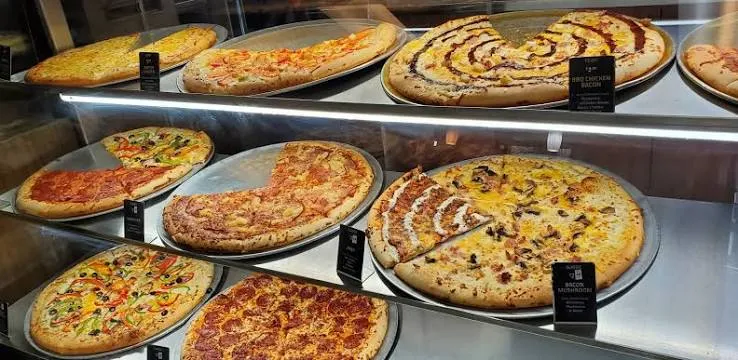
Pizza by the slice serves a different customer need from a made-to-order whole pizza.
The product needs to be ready when the customer arrives.
That creates convenience and speed. At the same time, the restaurant must balance availability against waste and product quality.
Too little product may leave the display unattractive or force customers to wait.
Too much product can increase waste or encourage food to remain on display longer than intended.
Consequently, operators need to understand customer traffic by:
- Daypart
- Day of the week
- Season
- Surrounding businesses or schools
- Walk-in traffic
- Pickup activity
- Delivery demand
A strong site and good forecasting can become important operating advantages in this type of model.
Multiple Ordering Channels Share One Kitchen
Freshslice can serve several types of customers from the same restaurant.
A walk-in customer may want a slice immediately. A family may order a customized whole pizza. Meanwhile, another customer may place a delivery order through a digital platform.
These channels can expand customer demand. However, they also share:
- Employees
- Preparation space
- Ovens
- Ingredients
- Packaging
- Management attention
A surge in delivery orders can affect the customer waiting at the counter. Likewise, a busy walk-in period can place pressure on pickup times.
For that reason, prospective owners should evaluate channel mix alongside labor, order accuracy, food costs, service times, platform charges, customer retention, and restaurant capacity.
The Fee Structure Deserves a Deeper Look
One of the most visible elements of the Freshslice Pizza franchise model is its fee positioning.
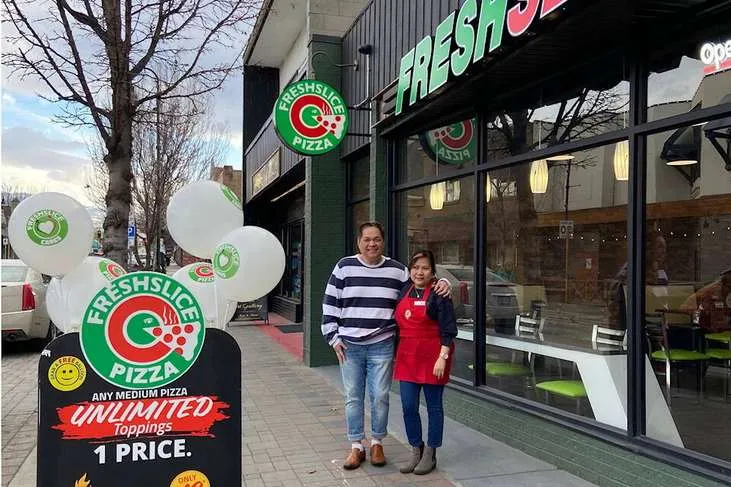
Freshslice publicly emphasizes that it does not charge a conventional percentage royalty or brand advertising fee on core-menu sales.
That can immediately attract attention because percentage royalties are common in franchising.
However, the absence of a conventional royalty does not mean there is no economic relationship between the franchisor and franchisee.
Freshslice’s model includes required products, approved suppliers, proprietary dough, technology, operating standards, local marketing responsibilities, and other contractual obligations.
Franchise materials indicate that the franchisor has an economic relationship with the proprietary dough production and distribution system.
Therefore, the better question is not simply:
A more complete question is:
The Elevare Perspective
A fee headline does not describe the complete economics of a franchise.
Evaluate every required payment, product purchase, supplier relationship, operating obligation, and support service together.
Required Purchasing Creates Both Consistency and Dependency
Centralized purchasing can support consistency across a restaurant system.
Customers should generally receive a recognizable product regardless of which location they visit.
Approved ingredients, equipment, packaging, and operating standards can also simplify training and quality control.
At the same time, required purchasing creates dependency.
Prospective owners should investigate:
- Where proprietary products are produced
- Which distributor serves the market
- Delivery frequency
- Frozen and refrigerated storage needs
- Minimum-order requirements
- Freight or distribution costs
- How product pricing may change
- What happens during shortages or interruptions
- Whether backup suppliers or contingency plans exist
These questions can become especially important as a franchise system expands into new geographic markets.
A Compact Footprint Does Not Make Real Estate Unimportant
Freshslice materials describe relatively compact restaurant locations, with formats generally oriented toward takeout and limited seating.
A smaller footprint may reduce certain occupancy or buildout requirements. In addition, electric cooking equipment may broaden the types of spaces that can potentially be considered.
Nevertheless, restaurant real estate remains critical.
A prospective location may still need:
- Visibility
- Appropriate customer traffic
- Parking or walkability
- Delivery-driver access
- Signage rights
- Suitable utilities
- Storage
- Waste handling
- Health and building approvals
- A lease that supports the operating plan
Local building, fire, mechanical, health, landlord, and insurance requirements still control what an individual site actually needs.
Turnkey Development Can Coordinate Work, Not Eliminate Risk
Freshslice materials describe support around site criteria, design, equipment, fixtures, signage, suppliers, and restaurant development.
Coordinating those elements can reduce the number of decisions a first-time restaurant owner needs to make independently.
However, “turnkey” should not be interpreted as effortless or guaranteed.
Development can still be affected by:
- Site availability
- Lease negotiations
- Landlord approval
- Permitting
- Utility capacity
- Construction conditions
- Equipment delivery
- Inspections
- Hiring
- Training
The physical build is only one portion of the complete signing-to-opening timeline.
Training Must Prepare More Than the Owner
Freshslice materials describe an on-the-job evaluation followed by additional management training and restaurant-based instruction.
The broader objective is not simply to teach someone how to make pizza.
A restaurant owner must understand:
- Opening and closing procedures
- Food safety
- Production standards
- Inventory
- Scheduling
- Customer service
- Cash controls
- Delivery-platform processes
- Labor management
- Local marketing
Employees and future managers also need repeatable training if the business is expected to grow.
What Does the Freshslice Owner Actually Do?
The standard first-location model described in the materials is hands-on.
Depending on the stage of the business, the owner may:
- Hire and schedule employees
- Monitor production and the slice display
- Manage food quality and cleanliness
- Receive deliveries
- Review inventory
- Monitor sales and labor
- Handle customer concerns
- Support local marketing
- Maintain operating standards
- Build relationships in the surrounding community
In other words, a compact restaurant should not automatically be interpreted as a part-time business.
Manager-led arrangements may be possible for certain qualified operators, but the materials indicate that these structures should be confirmed rather than assumed.
Even with a manager, the owner remains responsible for leadership, financial oversight, management accountability, capital, standards, and performance.
Our article What Does a Business Owner Actually Do? provides additional context for evaluating owner-operator, executive, and manager-led structures.
Restaurant Staffing Is Central to the Model
Restaurant labor affects much more than payroll.
Staffing influences:
- Operating hours
- Customer service
- Production speed
- Order accuracy
- Food safety
- Cleanliness
- Delivery performance
- Waste
- Owner involvement
Therefore, candidates should understand which positions are required, how difficult they are to recruit, how long training takes, and what happens when the restaurant is short staffed.
The centralized dough model may simplify certain production activities. However, employees still need to execute the remaining restaurant operation consistently.
Capital Planning Goes Beyond Opening the Restaurant
We are intentionally not publishing a Freshslice investment range in this Brand Spotlight.
The current Franchise Disclosure Document should be used to evaluate the applicable investment estimates and assumptions for a specific candidate and location.
More importantly, opening the restaurant is only one part of the capital plan.
A complete analysis should consider:
- Franchise and startup costs
- Site and lease costs
- Construction and equipment
- Inventory
- Training and opening expenses
- Business working capital
- Personal reserves
- Contingency capital
Restaurant expenses such as rent, payroll, utilities, marketing, inventory, and debt service can begin before the customer base has fully developed.
That is why the Total Capital Requirement for Business Ownership is more useful than focusing only on the initial purchase or opening estimate.
Our guide to Understanding Working Capital for Business Owners provides additional context for planning the ramp-up period.
The Elevare Perspective
A manageable opening cost does not guarantee a manageable ownership transition.
Capital planning should include both the business and the household while the restaurant develops.
How Might Freshslice Scale?
Restaurant scalability is different from simply increasing the number of customers at one location.
Growth may come from:
- Increasing customer traffic
- Improving repeat business
- Increasing pickup and delivery volume
- Building catering or group-order activity where appropriate
- Opening additional locations
- Developing managers
- Building multi-unit infrastructure
The key question is whether the systems, people, capital, supply chain, and management structure can support that growth.
An owner who opens another restaurant before developing a stable first-store team may simply multiply staffing, quality, inventory, and control problems.
Our What Makes a Business Scalable? article explains how demand, systems, people, capacity, management, capital, and replicability work together.
Who May Be Well Suited to This Model?
Restaurant experience may be helpful, but the more important question is whether the prospective owner is comfortable with the responsibilities of this particular operating model.
Relevant strengths may include:
- Hands-on leadership
- Comfort hiring and coaching employees
- Attention to detail
- Financial discipline
- Customer-service orientation
- Ability to follow operating systems
- Comfort with inventory and operating controls
- Local relationship building
- Schedule flexibility
- Patience with real estate and development
- Interest in developing managers and additional locations
By contrast, the model may be less aligned with someone seeking immediate passive ownership, broad freedom to change suppliers or operating procedures, or a business without employee-management responsibility.
The Business Ownership Self-Assessment can help prospective owners evaluate that personal alignment before making a business decision.
The Elevare Business Model Lens
| Evaluation Area | Questions to Investigate |
|---|---|
| Customer Demand | Who supports slice, whole-pizza, pickup, and delivery demand in the proposed trade area? |
| Revenue Model | How do walk-in, whole-pizza, pickup, delivery, and other channels contribute to the sales mix? |
| Production | Which tasks are simplified by centralized dough, and which responsibilities remain at the restaurant? |
| Supply Chain | How are proprietary dough, required products, distribution, pricing, storage, and contingency planning managed? |
| Staffing | How many employees are required, which positions are difficult to fill, and how does labor change with volume? |
| Real Estate | What traffic, visibility, utilities, access, permitting, and lease characteristics does a successful site require? |
| Owner Role | What must the owner personally do during development, opening, ramp-up, and mature operations? |
| Economics | How do required purchases, product costs, suppliers, fees, labor, occupancy, technology, and local marketing work together? |
| Scalability | Can managers, systems, supply chain, and capital support additional locations? |
| Personal Alignment | Does restaurant ownership fit the individual’s strengths, lifestyle, financial capacity, and long-term goals? |
Questions to Ask Existing Freshslice Franchisees
Validation can help determine how the model operates beyond the presentation.
Useful questions may include:
- How long did it take from signing to opening?
- Which part of development took longer than expected?
- How did actual opening costs compare with the original plan?
- How much working capital did you ultimately need?
- Which dayparts and customer channels are most important?
- How difficult is forecasting pizza-by-the-slice demand?
- What does waste look like in practice?
- How reliable has product distribution been?
- Which employees are hardest to recruit and retain?
- How much time do you spend in the restaurant?
- Which franchisor support resources have been most useful?
- How much local marketing does the owner need to perform?
- What surprised you after opening?
- What would you do differently if you opened again?
- What type of owner is most likely to struggle in this system?
For a broader validation framework, review Franchise Validation: Questions to Ask Existing Franchise Owners.
The Elevare Perspective
Validation is most useful when it tests a specific assumption.
Ask several owners the same factual question, compare their answers, and investigate whether differences result from the market, site, owner, stage of development, or franchise system.
Due Diligence Should Test the Complete Model
A prospective Freshslice owner should review more than the customer experience or fee headline.
Due diligence may include:
- The current Franchise Disclosure Document
- The franchise agreement and related contracts
- Item 7 investment assumptions
- Item 8 purchasing requirements
- Item 19 information if provided
- Franchisor financial statements
- Supplier and distribution relationships
- Site and lease economics
- Local wages and staffing conditions
- Market demand and competition
- Validation with existing owners
- Owner-role requirements
- Independent legal and financial review
Our cornerstone guide, Business Ownership Due Diligence: What to Evaluate, explains how these areas work together.
The Elevare Perspective on Freshslice Pizza
The most useful question is not:
“Is Freshslice Pizza a good franchise?”
A better question is:
“Does the Freshslice Pizza business model, owner role, operating complexity, capital requirement, site strategy, supply chain, and growth path align with me?”
Key Takeaways
- Freshslice uses centralized proprietary dough production to change selected in-store preparation requirements.
- Centralized production can simplify some restaurant activities while increasing dependence on manufacturing and distribution.
- Pizza-by-the-slice service requires careful forecasting, quality control, and waste management.
- Walk-in, whole-pizza, pickup, and delivery demand share the same employees and operating capacity.
- A compact restaurant footprint does not eliminate the importance of real estate, permitting, utilities, and lease economics.
- The absence of a conventional percentage royalty should be evaluated within the complete economic and contractual relationship.
- The standard first-location model is hands-on; manager-led ownership should be confirmed rather than assumed.
- Restaurant staffing directly affects capacity, customer experience, food safety, owner involvement, and scalability.
- Opening costs are only one part of the total capital requirement.
- Scalability depends on developing repeatable systems, managers, capital, and a reliable supply chain.
Frequently Asked Questions About the Freshslice Pizza Franchise
What is the Freshslice Pizza franchise business model?
Freshslice combines pizza by the slice, customizable whole pizzas, pickup, and delivery within a generally compact restaurant format. Its operating model also uses centrally manufactured proprietary dough rather than producing every dough component from scratch at each restaurant.
Does Freshslice charge royalties?
Freshslice publicly emphasizes that it does not charge a conventional percentage royalty or brand advertising fee on core-menu sales. However, prospective franchisees should review the current FDD and agreements to understand required products, supplier relationships, technology, local marketing obligations, other charges, and the complete economic relationship.
Does centralized dough eliminate restaurant preparation?
No. Centralized dough changes selected preparation steps. Restaurant employees still receive and store products, proof crusts, prepare ingredients, assemble and bake pizzas, manage orders, clean equipment, follow food-safety requirements, and serve customers.
Is Freshslice a passive or semi-absentee franchise?
The standard materials emphasize active owner involvement, particularly for the first restaurant. Manager-led arrangements may be available for certain qualified operators, but approval, responsibilities, and contractual requirements should be confirmed directly with the franchisor and in the current agreements.
Does a smaller restaurant mean the business is easier to operate?
Not necessarily. A compact footprint may reduce some space and construction requirements, but the restaurant still requires staffing, food safety, inventory management, production, customer service, delivery coordination, marketing, financial controls, and active management.
Can Freshslice scale to multiple locations?
Multi-unit growth may be possible, but additional locations require management, staffing, capital, real estate, supply-chain capacity, and operating systems. Prospective owners should understand how successful multi-unit operators develop managers and stabilize each restaurant before expanding.
How should a prospective owner evaluate Freshslice?
Review the current FDD and agreements, evaluate the local market and site, understand the owner role and staffing model, develop a complete capital plan, investigate supplier and distribution requirements, speak with existing franchisees, and obtain appropriate legal, financial, tax, lending, and other professional guidance.
Continue Your Learning
Freshslice provides one real-world example of how business-model design, owner role, staffing, capital, and scalability interact. Continue exploring these concepts in the Elevare Learning Center.
What Makes a Strong Business Model?
Evaluate customer demand, revenue, systems, staffing, owner dependence, and other characteristics of the underlying business.
What Makes a Business Scalable?
Understand how demand, systems, people, capacity, management, capital, and replicability influence sustainable growth.
What Does a Business Owner Actually Do?
Compare owner-operator, executive, and manager-led roles and how those responsibilities may evolve as a business develops.
Total Capital Requirement for Business Ownership
Consider startup capital, working capital, personal reserves, and contingency capital together rather than focusing only on the cost to open.
Franchise Validation: Questions to Ask Existing Franchise Owners
Use structured conversations with existing franchisees to test assumptions about startup, staffing, capital, support, owner role, and operating realities.
Business Ownership Due Diligence: What to Evaluate
Bring together business-model analysis, capital planning, validation, contractual review, market research, professional guidance, and personal fit.
This article is provided solely for general educational purposes and is not an offer to sell, solicitation, endorsement, or recommendation of the Freshslice Pizza franchise or any other business opportunity. Franchise information, fees, contractual terms, supplier arrangements, ownership requirements, training, support, and operating practices may change. Prospective franchisees should rely on the current Franchise Disclosure Document, executed agreements, direct information from the franchisor, independent market research, franchisee validation, and qualified professional review. Financial and operating results vary, and no revenue, profitability, return, resale value, or other business outcome is promised or projected. Elevare Advisory Group provides education and strategic guidance to help individuals thoughtfully evaluate new franchise and non-franchise business opportunities. Elevare does not charge clients an advisory or placement fee at any stage. Elevare may receive compensation from a franchisor or business opportunity provider if a client proceeds. Independent attorneys, accountants, lenders, financial analysts, and other professionals bill clients separately for their services.